Merino Jobs Operations
Dynamic Wikipedia Indexer Job
Merino currently builds the Elasticsearch indexing job that runs in Airflow.
Airflow takes the latest image built as the base image.
The reasons to keep the job code close to the application code are:
- Data models can be shared between the indexing job and application more easily. This means that data migrations will be simpler.
- All the logic regarding Merino functionality can be found in one place.
- Eliminates unintended differences in functionality due to dependency mismatch.
If your reason for re-running the job is needing to update the blocklist to avoid certain suggestions from being displayed, please see the wikipedia blocklist runbook.
Where the exports come from
The copy-export step reads Wikimedia's CirrusSearch index dumps from
https://dumps.wikimedia.org/other/cirrus_search_index/. That listing holds one directory per
weekly snapshot (20260816/), and within each snapshot one directory per index
(index_name=enwiki_content/). Upstream shards each index into many bzip2 files to parallelize
dump generation — English is currently around 66 shards of roughly 630 MB each.
The job traverses snapshots newest-first and copies the shards of the first complete one to GCS, one object per shard, under a prefix named for the snapshot:
<gcs_path>/<lang>wiki-<date>-cirrussearch-content/
    <lang>wiki_content-<date>-00000.json.bz2
    ...
    _SUCCESS
Shards are copied three at a time. dumps.wikimedia.org states that "Downloads are also rate limited and capped at 3 connections per-IP" and blocks clients that work around it. DOWNLOAD_CONCURRENCY in filemanager.py must not be raised.
Success markers
A snapshot only counts as complete once Wikimedia writes a _SUCCESS marker beside its shards, which happens roughly 12 hours after the directory first appears. A snapshot without the marker is skipped in favour of the previous one, so a run logging Currently up to date shortly after a new snapshot appears is expected rather than a failure.
Resuming a failed copy
A failed copy-export leaves whatever shards it managed to copy in place and does not write the marker. Re-running it skips shards already on GCS at their upstream size and re-fetches the rest, so a retry resumes rather than re-transferring all shards. A shard that was truncated by a failed write
has the wrong size and is re-copied.
Note that objects from the previous single-file layout
(<lang>wiki-<date>-cirrussearch-content.json.bz2) are ignored, not deleted. They can be removed manually once a run under the new layout has succeeded.
Running the job in Airflow
Normally, the job is set as a cron to run at set intervals as a DAG in Airflow. There may be instances you need to manually re-run the job from the Airflow dashboard.
Grid View Tab (Airflow UI)
- Visit the Airflow dashboard for
merino_jobs. - In the Grid View Tab, select the task you want to re-run.
- Click on 'Clear Task' and the executor will re-run the job.
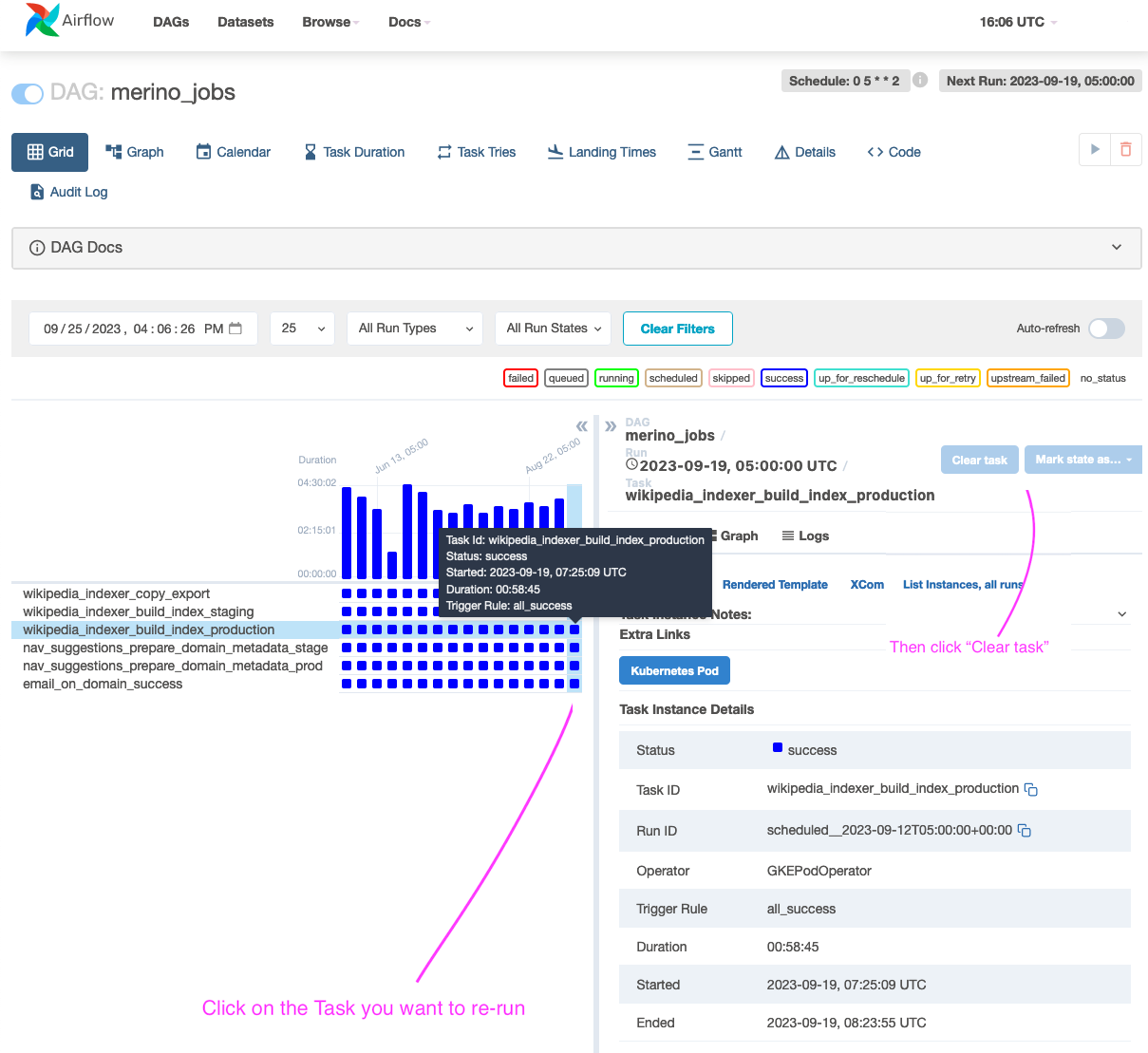
Graph View Tab (Airflow UI) - Alternative
- Visit the Airflow dashboard for
merino_jobs. - From the Graph View Tab, Click on the
wikipedia_indexer_build_index_productiontask.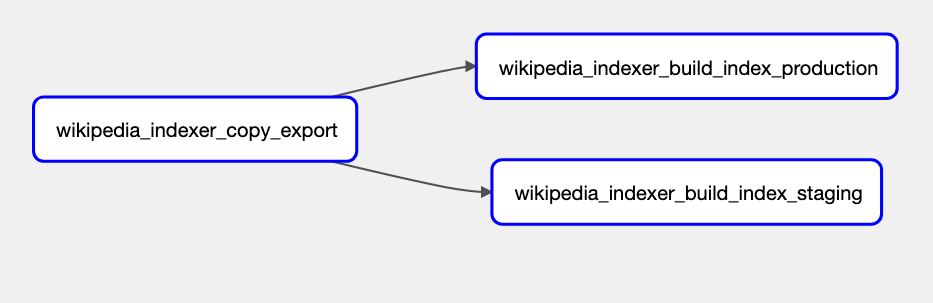
- Click on 'Clear' and the job will re-run.
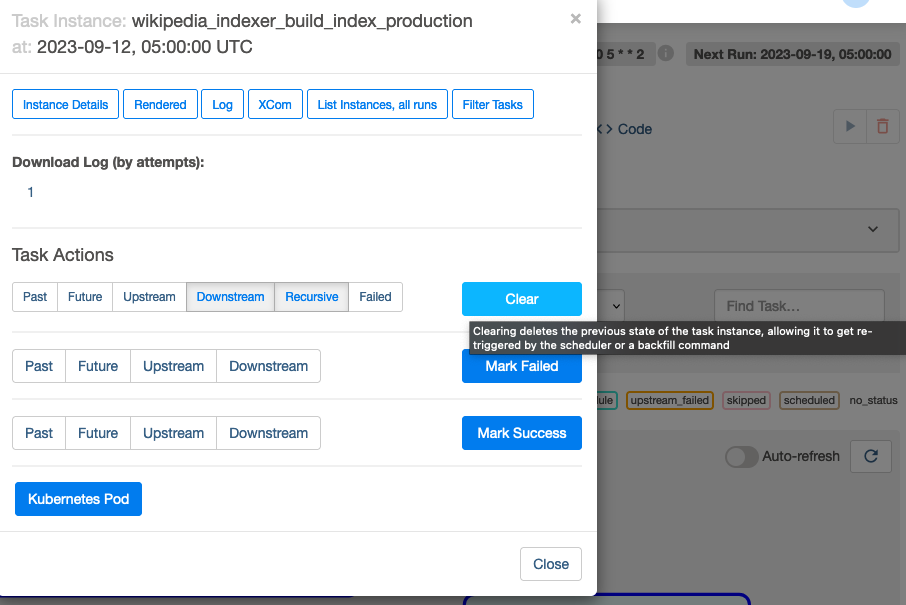
Note: You can also re-run the stage job, but the changes won't reflect in production. Stage should be re-run in the event of an error before running in prod to verify the correction of an error.
See Airflow's documentation on re-running DAGs for more information and implementation details.
To see the code for the merino_jobs DAG, visit the telemetry-airflow repo. The source for the job is also in the 'code' tab in the airflow console.
To see the Wikipedia Indexer code that is run when the job is invoked, visit Merino jobs/wikipedia_indexer.